
Better Scores in LSR Rifle
How to do nothing and win — let your bones take the strain, and the wobble has nowhere to live.

Introduction
If you are shooting in competitions, your scores won't improve on their own. Practice helps — but rehearsing the same mistakes over and over again will just make matters worse, or at best, won't result in improvement.
The greatest challenge to overcome in LSR is wobble.
You set up to squeeze the trigger, then the cross-hairs drift away from the 10 ring. You adjust by moving the rifle in the opposite direction. It goes too far. You bring it back. You repeat the process numerous times on two axes and eventually pull (unfortunately, not squeeze) the trigger when your left arm is protesting — or when you have turned purple because you have forgotten to breathe. There is a better way.
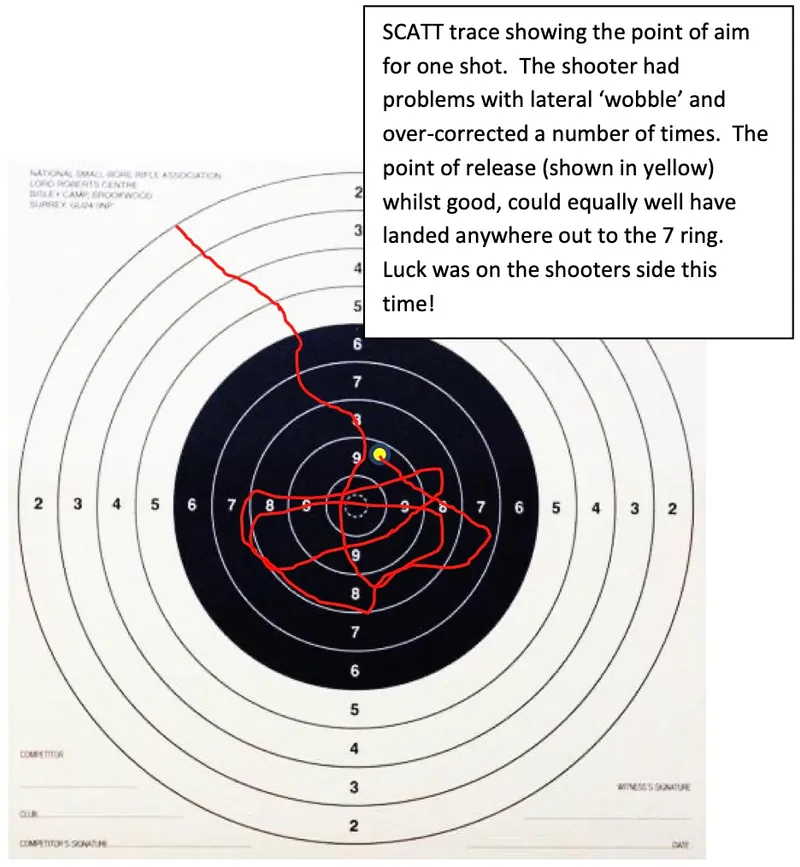
Our muscles are arranged in antagonistic pairs — one pulls in one direction, another pulls back. If we rely on muscles to keep the cross-hairs on the 10 ring, we enter the tunnel of doom. Wobble will always win. The only way to score a 10 by this means is by luck.
Ever get flyers? They're caused when muscles twitch in protest at the load they're taking. The solution to twitch and wobble is the same: do nothing.
This guide assumes a right-handed shooter. Reverse the instructions if you shoot left-handed.
How to do nothing and win
When we do something, we move. Movement involves muscles. As soon as muscles fire in shooting, we twitch or wobble. The trick in LSR is to reduce muscle use to a minimum: do nothing. That way the cross-hairs stay in the 10 ring long enough for a thoughtful squeeze, not a panic-attack-induced pull.
The way you achieve this is through body position. Let your bones take the strain.
Body position
There is more variation of position in LSR than in, say, prone shooting — but the basics still matter, and ignoring them costs you consistency.
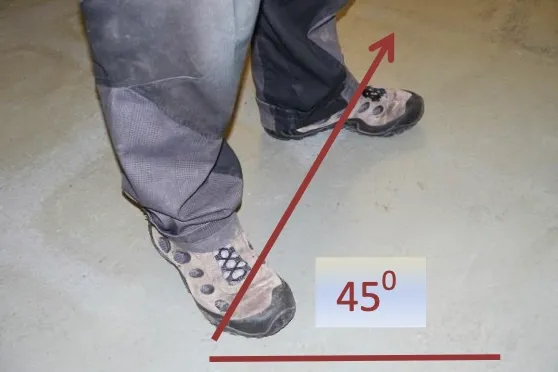
- Body about 45° to the target. Left foot and shoulder forward of your body, left foot pointing at the target. Feet roughly shoulder-width apart.
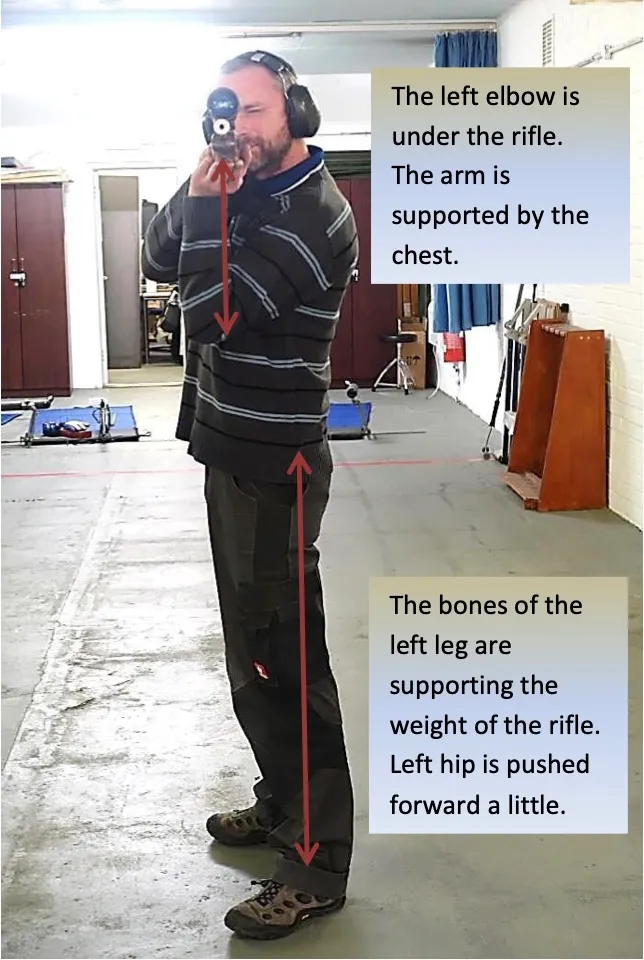
- Lean back slightly, and a little to the right. This puts your centre of gravity between your left leg and your body centre. Your left hip pushes forward a little — it'll support your left elbow.
- Weight on the bones of your left leg, not on muscles. This is the foundation of the position; everything above it depends on getting this right.
- Shoulder the rifle, butt firmly in position. All of the butt-plate should be in contact with your shoulder if your rifle allows it (see the note below).
- Left elbow across your chest, under the rifle. This is the most important position cue. If it's uncomfortable, get the elbow as close to under the rifle as you can; over a few weeks, soft tissue adjusts and you can move it further. The bones of your left arm support the rifle, not your muscles.
- Left hand under the fore-end as a rest, not a grip. Don't reach forward — that loads the left arm muscles. Hand under the trigger guard is fine. Don't grip; gripping causes muscle fatigue and transmits a pulse into the rifle. Flatten your hand.
- Bring the rifle to your eye level. Cant left or right is fine — provided it's consistent every shot.
- Cheek on the stock, eye in line with the scope, about 6 cm behind it. If you see a tunnel, move your eye closer.
- Scope in focus. Cross-hairs and target both sharp. Magnification of more than 6× magnifies wobble beyond control. Get a fellow shooter to help focus while you hold position.
- Take the shot in a pause on an inhaled breath to reduce the work the weak rib-cage muscles have to do. Squeeze gently. Don't pull. Take your time. Don't try to empty the magazine on one breath — rest between shots if you need.
Flatten your left hand under the fore-end. Curled fingers will be singed and bruised by ejected cartridge cases.
A note on butt plates
In theory, all of the butt-plate should be in contact with the shoulder. In practice, this can be hard to achieve — particularly with shared club rifles, where the butt-plate may not adjust up or down enough to suit your build. The same is true for some prone and benchrest rifles.
There's no easy answer. If you eventually buy your own LSR rifle, make sure it has butt-plate adjustability. You can also buy different-length scope risers so the scope sits at the correct height for you.
That's quite a lot of nothing to be getting on with. Happy, safe, and wobble-free LSR shooting to you all.
Browse the training library
In-depth coaching articles on technique, equipment, and safety from Pinhoe TSC instructors.