
Owning an FAC
A members' guide to applying for a UK Firearms Certificate — the law, the costs, the form, and what to expect from the police visit.

This article was first written in 2022 and refreshed in 2026 with current fees. UK firearms law and police-force procedures change — for anything material to your application, always check the current rules with Devon & Cornwall Police Firearms Licensing directly. The author is not a legal expert.
Introduction
If you're approaching full membership at Pinhoe TSC, you may be thinking about how that status could change your shooting at the club. This article focuses on one aspect: the possibility of owning an FAC (Firearms Certificate), which lets you own your own rifle.
UK firearms law is amongst the strictest and most complex in the world. In most cases, owning a firearm is a privilege, not a right.
There's one important distinction. Every British citizen is deemed the right to own a shotgun — the state has to show why someone shouldn't. With a rifle, it's the other way round: you have to demonstrate the need to own one. Owning a shotgun certificate, or having served in the Armed Forces, gives no privileged access to a rifle FAC.
Air rifles up to 12 ft·lbs of pressure — the type used for target shooting in our club — do not require a licence in England and Wales. The position differs in Scotland.
Why should I be interested in an FAC?
Owning an FAC lets you own your own rifle. There's no theoretical reason you can't continue using a club rifle indefinitely — Pinhoe TSC holds its rifles on its own FAC. But as your skill level rises, you may want to make a rifle fit you rather than fitting yourself to whatever's available.
Club rifles are shared. You can't permanently set one up to suit your shooting style, your body, or your eyesight. That can be particularly frustrating in competition where your groups need to be in the centre of the target. Using a club rifle is the perfect way to reach a sound level of proficiency — but you may eventually hit a plateau that only your own rifle will let you push past.
Are you left-handed with right-eye dominance? Have a sore back? Long arms? These are exactly the kinds of issues that resolve much more easily once you have your own rifle.
Assumptions
This guide assumes:
- You will be over 14 when you apply for your FAC.
- You're considering buying a live-firing .22 rifle.
- The rifle is for your use only.
- You'll use it at Pinhoe TSC, or another approved club. (Ask for Condition 9 from Appendix 3 of the Home Office guide to be applied to your FAC, or you'll be restricted to shooting at Pinhoe TSC only.)
- You'll be storing your rifle and ammunition at home in compliance with UK firearms law. The club has limited provision for private gun storage — speak to the club armourer before you apply.
- You'll be able to transport your rifle and ammunition to and from the club lawfully.
Under-18s. Persons aged 14–18 may be granted a firearms certificate but may not purchase a firearm or ammunition until they are 18. They may be gifted or lent a firearm and ammunition if they hold the certificate. If you're a junior member, this route may be open to you provided you can satisfy the firearms authority that you're a suitable candidate. Club membership helps.
Rifle or certificate first?
In an ideal world you'd get the FAC before paying for a rifle. In practice, both processes have lengthened in recent years.
- New rifles are mostly imported from the EU and dealers often only order on demand — lead times can run into months.
- FAC applications themselves now typically take months rather than weeks to process.
A firearms dealer can hold a rifle for you until your FAC is granted (usually for a storage fee). Second-hand rifles in the UK turn around faster but with more limited choice.
If you already hold a shotgun certificate, consider applying for a coterminous FAC — one expiry date covers both certificates, which the police prefer and which costs less than paying separately.
What does it cost?
The fees below are the standard England-and-Wales fees set by the Firearms (Variation of Fees) Order 2025, in force from 5 February 2025:
| Application | Fee | |---|---| | Grant of firearm certificate | £198 | | Grant of shotgun certificate | £71 | | Renewal of firearm certificate | £131 | | Renewal of shotgun certificate | £24 | | Replacement of lost/destroyed FAC or SGC | £9 | | Variation of FAC | £47 | | Coterminous: SGC grant + FAC renewal | £202 | | Coterminous: SGC renewal + FAC renewal | £155 |
A variation is any alteration to your existing certificate — increasing or decreasing your ammunition allowance, or adding a firearm.
You'll also need to budget for a GP medical report (since 2021), which is not a fixed-fee item — some GPs charge nothing, others substantially. There's currently no national cap.
Always check the current fees with Devon & Cornwall Police Firearms Licensing before you submit. Fees are reviewed periodically; the table above will go out of date.
How to apply
You can apply online or by post. Devon & Cornwall Police's Firearms & Explosives Licensing Department is your licensing authority. The current online form, paper form (Form 201), and the GP medical form are all linked from the Devon & Cornwall licensing pages — start there for the up-to-date documents.
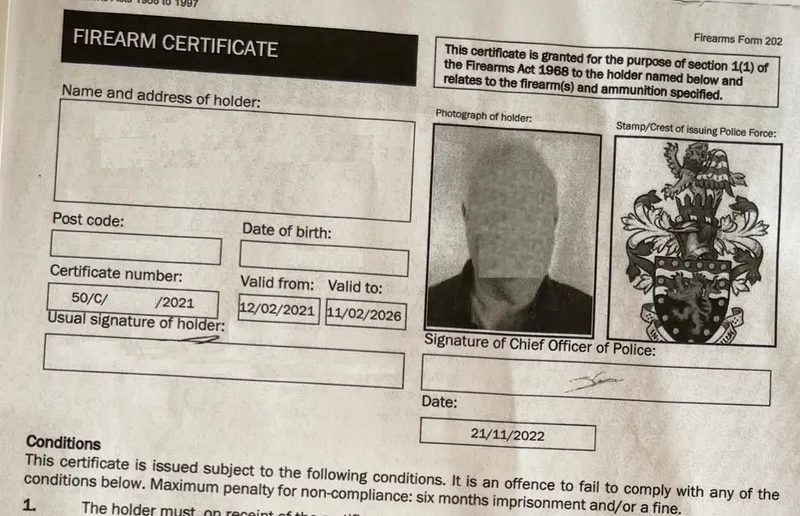
Direct quote from the regional firearms department:
If applying via our secure online application form or via post, your application will be placed as 'pending' and therefore not completed until we have received your GP report. The Firearms Licensing Department will be in contact with you as soon as we start to process your application. Before we contact you, unless absolutely necessary, please do not make further enquiries with us about your application as this administration may cause further delays.
The police recommend submitting your application in advance of your GP report if necessary, to avoid further delays — though processing only begins once both are in hand.
Filling in the form
Two key words: carefully and honestly. Read the notes that come with the application form before you start.
Part A — Personal details
Block capitals. Unclear handwriting causes delays. Electronic completion is preferable where the form supports it.
Part B — Medical history
You'll be signing to allow the police access to your medical records. Be candid; reservations don't get you out of compliance.
Part C — Convictions
Be completely honest, even with old or felt-wrongly-convicted offences. Each case is dealt with individually.
Part D — Items 14, 15, 16, 17
- Item 14 — existing firearms. Skip if you don't have any.
- Item 15 — the rifle you intend to acquire. If a dealer is holding one for you, get the make, model, and serial number from them. Calibre will be
.22"if you intend to shoot it at Pinhoe TSC. Type will be either single-shot bolt action or self-loading semi-automatic. Reason for possession — target shooting at Pinhoe Target Shooting Club. - Item 16 — type and amount of ammunition. Type:
.22. The amount you apply for is not always what you get on your licence. 500 rounds (10 boxes) is conservative; 1,000 or 2,000 is more useful for regular shooters. The more you ask for, the lower the chance of getting it on a first application. Use the continuation sheet on the last page to make a case.
Sample wording for an ammunition allowance above the default (continuation sheet): "I am a competition target shooter. It is important for me to buy ammunition in tested batches of at least 1,000 rounds to ensure consistency of performance. An allowance of 1,500 rounds on my licence will be a significant help to my competition performance."
- Item 17 — home security. Covered in detail below.
Home security and the police visit
At a later stage in your application you'll receive a planned visit by a police firearms officer. The officer has two purposes:
- Personality and medical assessment — a conversation that lets the officer make their own read on your suitability and on anything raised by your GP.
- Security check — your home is inspected to confirm safe storage.
What they're looking for:
- No outbuilding or garage storage for firearms.
- A gun safe (cabinet) made and secured to a specified standard.
- Cabinet placed somewhere inconspicuous, ideally not on the ground floor.
- Keys kept secret — known only to you. If asked where they are, say "in a secret location." That's the answer they want.
- A house alarm helps but isn't required.
Under-18 certificate holders. When a firearm or shotgun certificate holder is under 18, an individual aged 18 or over (parent, guardian, or another certificate holder) must assume responsibility for secure storage. The non-certificate-holding adult may instead share access via a cabinet with two separate locks that can only be opened when both key-holders are present, provided one of those key-holders is themselves a certificate holder.
Choosing a gun safe
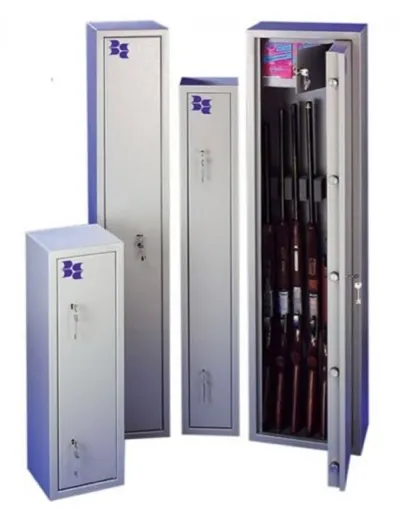
There's plenty of choice — utilitarian metal cabinets through to disguised furniture. Modern safes can have personal codes or fingerprint locks instead of (or as well as) keys. Any reputable firearms dealer can advise.
A few practical pointers:
- Separate ammo compartment with separate keys is very useful — it lets you store ammunition independently of the rifle.
- Mind the wall. Many modern houses have soft internal walls that won't take a serious anchor. The firearms officer will give the safe a good pull during the visit; if the wall moves, that doesn't inspire confidence.
- Bolt count. Fix the safe with at least 4 large bolts. Many safes accommodate 6.
Part F — Referees
You'll need to provide details of two referees who have known you for at least 2 years. This rules out most club members in your first 2 years of membership unless you have other long-standing connections at the club.
Speak to your referees in advance of submitting your application — they may need to be aware of what's involved.
Final checklist
Before sending your application off:
- Completed firearms application form — keep a copy for your records.
- Four passport-sized photos — two signed and dated on the back by a referee, one signed and dated by you, one blank.
- Proof of club membership (membership card or a note from a committee member).
- Cheque for the application fee, made payable to the licensing body.
- A covering letter, if you need one — special health or family circumstances are worth explaining concisely.
- Confirm both referees are sending their references back promptly.
If you have questions about your application, talk to an experienced club member first — many of us have been through the process and can save you a lot of time.
Best of luck with your application.
Browse the training library
In-depth coaching articles on technique, equipment, and safety from Pinhoe TSC instructors.