
Your First Match
Most league shooting at Pinhoe is postal — you shoot on a club night, the card goes in the post. This guide is about the other kind: turning up in person at someone else's range, shoulder-to-shoulder. The kit, the prep, the etiquette, and the calm head that gets you through. By Robert Beard.

Introduction
When Pinhoe shooters talk about competitions, most of the time they mean postal — you shoot a card on a club night, a Range Conducting Officer witnesses and signs it, the team captain submits the scores. That's covered in the leagues page and in our competition shooting article.
This article is about the other kind: shoulder-to-shoulder. You and the other competitors physically show up at the same venue on the same day, shoot under the same conditions, and the prize-giving happens that afternoon. Local clubs (Okehampton, Yealmpton, Bideford), county opens, and national meets at Bisley or Aldersley all work this way. Different rhythm, different prep, different etiquette — and a great experience once you've done your first one.
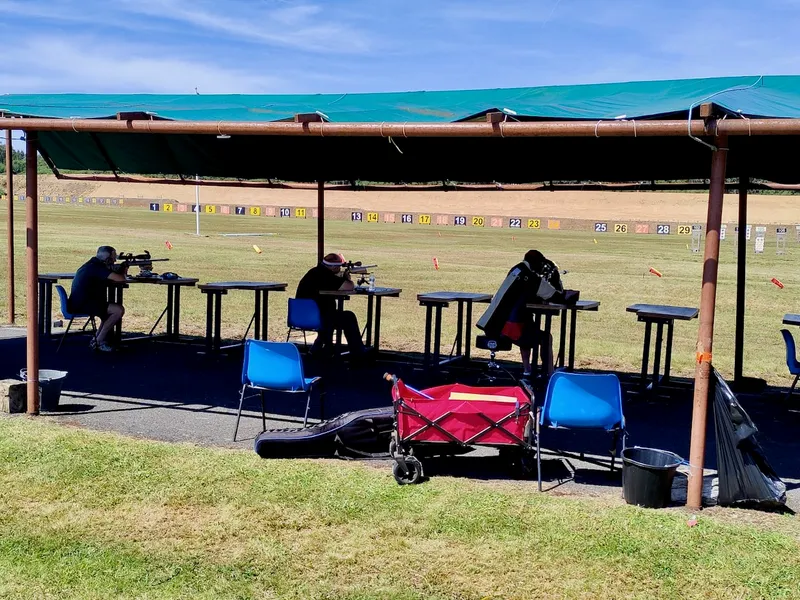
Formats and classes
Shoulder-to-shoulder events are usually individual entries, though some have a pairs category you can enter with a club mate. Team events also exist but are less common at this format.
Your skill level is set by your recent averages, certified by a club official (usually the discipline captain). At most shoulder-to-shoulder events you'll be placed in a class — typically X, A, B, C or D, with X for the top shooters and D for newcomers. Prizes are awarded for top places in each class so you're not competing against the national team on your first outing. Additional categories often include Best Lady, Veteran and Junior.
The point: you don't need to be the best shooter in the room. You need to be the best shooter in your class.
Before you go
Enter early. Register well in advance, complete the entry form and pay the fee. Read the competition rules — local rules or NSRA rules as applicable — more than once. Ask a senior club member if anything is unclear.
Plan the trip. Calculate travel time and arrive at least an hour early. Traffic, parking, finding the right firing point at an unfamiliar venue — they all eat time. If the event is far enough that you'd be driving home tired, plan accommodation; many shooters share an Airbnb or B&B for multi-day meets and split costs.
Pack your gear — the day before, not the morning of:
- Rifle, in its case
- Ammunition — batch-tested for consistency
- Spotting scope
- Timer or stopwatch
- Competition targets
- Backer cards for outdoor events — a plain card hung behind your target to detect cross-shots from neighbouring firing points
- Coloured bulldog clips or a marker pen to clearly identify your target by firing-point number
- Eye and ear protection
- A waterproof, layers — outdoor matches go ahead in most weather
Optionally, an old target placed behind the competition target can improve contrast in bright sunlight. Check with organisers first.
Batch-test your ammunition well before the match. Show up with one batch you trust, not three you're hoping work — switching batches mid-card costs you points.
On arrival
National venues like Bisley are large — multiple ranges, separate prep rooms, a clubhouse, a scorer's hut. Use your hour of slack to find:
- Your firing point
- The toilets
- Where to hand in cards for scoring
- Where the prize-giving will happen
Watch the prior detail if there is one. Assess the wind. Then prepare your kit at the firing point in the order you'll need it.
Hang your target the moment you reach your firing point. If the Range Officer calls "NO MORE TARGETS" and yours isn't up, you can't shoot — and there are no second chances. Use your coloured bulldog clips or firing-point number on the target so you and the scorers can identify it later, especially if a cross-shot ends up on it.
Arrange gear — scope, ammo, timer — to minimise movement during the match. Less reaching, less searching, less mental load while you're trying to shoot.
During the match
Shooting at a strange range, in front of strangers, with a competition sticker on your target, is a different kind of pressure to a Tuesday club night. The technique that works:
- Block out distractions. Movement beside you, noise, crowd chatter. Focus on your shot process — aim, breathe, squeeze while your chosen wind condition prevails. You must not tune out the wind itself.
- Treat each shot as a mini-match. Aim for consistent 10s, one shot at a time.
- Use sighting shots wisely. Outdoors, fire sighters to gauge wind impact and shoot when the near and far flags align in a consistent, mild condition. When switching distances (50 m to 100 yd, say), aim high on your first sighter so you don't score a miss. If the flags are still or wet, watch grass, leaves or competitor gun smoke for wind cues.
- Don't make excuses. "The wind got me." "The ammo failed." Note the weakness, plan the improvement, move on.
After the detail, collect your target and backer and submit them for scoring. If a cross-shot occurs — yours or someone else's — align the target and backer to identify the stray shot. Mark any cross-shot with an arrow and "X shot" to help the scorers. You can score your own card visually to estimate the result; if the official score seems off, you can challenge it — usually for a small fee, around £1.
Etiquette
You're a guest at someone else's club. The same range courtesies you follow at Pinhoe apply here, but visibly.
Do:
- Obey the Range Officer's commands at all times.
- Apologise promptly if you cross-shoot or disrupt others (shouting during a detail, for example).
- Observe other shooters' techniques and ask questions politely — with permission, between details, never on the line.
- Keep your firing point tidy and leave it clean.
- Thank the organisers and Range Officers on your way out.
Don't:
- Touch anyone's equipment without permission.
- Handle your rifle or gear between details, and never when people are downrange.
- Discuss the competition or other shooters negatively during the event — sound carries, the venue is small, and everyone hears.
Raising issues
If you suspect a rule violation — unsafe shooting, equipment outside the rules, tampering with shot cards — handle it promptly and professionally.
- Act during the event. Report the issue to the Range Officer or, ideally, the Shoot Organiser while the detail is still on, when the evidence (position, equipment) is observable.
- Be discreet. Approach the official privately to avoid escalating tensions or disrupting the shoot.
- Be specific. Describe the issue clearly: "I noticed Shooter X adjusting their target after collection, which may violate rule Y."
- Avoid confrontation. Never accuse another shooter directly or discuss suspicions with others — that's unsporting and potentially legally problematic.
- Trust the process. Let the Range Officer or Organiser investigate and resolve it. Their decision is final.
Most issues are minor — cross-shooting handled by backers, a small disruption resolved with an apology and a re-sight. For anything serious, rely on officials to act.
First-match nerves are normal. Travel light on expectation: your goal for the first event isn't to win, it's to complete the experience — arrive on time, hang the target, shoot the card, hand it in, stay for the prize-giving. The score will come with experience. Good luck, and shoot straight.
Find your next match
Speak to your discipline captain about away-match opportunities, or browse the calendar for upcoming events you can shoot in.