
Zeroing Your Prone Rifle
Tight groups don't guarantee centre hits. Here's how to move the group to where it should be.

Introduction
The rear-sight block on a prone rifle is also called a dioptre sight. A dioptre sight has a tiny peep-hole in the centre of a disc through which you look. The peep-hole increases what's known as your depth of field — letting you see the front sight in focus and a reasonably in-focus target 25 yards away at the same time.
Lenses are not allowed in this sight block. A lens would turn it into a telescope, which isn't permitted in prone competition. The rear sight works in conjunction with the front sight (also called the foresight) — the elements of both have to be aligned with the target as a single composite picture.
Correct alignment of foresight and rear sight does not guarantee you'll hit the centre of the target. With the right technique it'll guarantee tight groups — but to land those groups in the centre, you have to move the internal components of the rear sight up, down, left, and right. That is zeroing.
Rear-sight anatomy
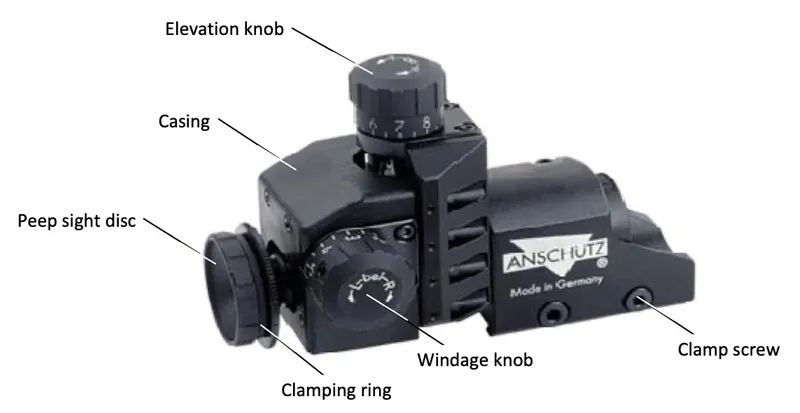
The 13-step process
Set yourself up for shooting as usual.
- Put a prone target card on the target board.
- Set up a scope so you can view results from your firing point.
- Have plenty of ammunition available.
- Attach your sling and get into position. Find your natural point of aim — see Natural Point of Aim if you haven't already.
- Put 5 rounds into the top-left target.
- If they're scattered all over the target, repeat step 5 on a fresh target.
- If your shots are still scattered widely, stop. Zeroing now will not help — your technique needs work first. Come back to this lesson once your groups are tight.
- Once your group falls within roughly a 2 cm diameter, you're ready to zero.
- Start with windage (horizontal). On the windage knob: if your group is to the left of centre, wind the knob 10 clicks toward you; if your group is to the right of centre, 10 clicks away from you.
- Put 5 more rounds onto the same target you just used. Note which way the group has moved.
- Repeat windage adjustments until the centre of your group is aligned with the centre vertically. Use fewer clicks for fine adjustment.
- Now elevation (vertical). On the elevation knob: if your group is too high, wind 10 clicks to your right; if too low, 10 clicks to your left.
- Repeat elevation adjustments until the group centres on the target. You have now zeroed your rifle.
Avoid chasing the centre with constant windage and elevation tweaks. If your group is wandering, the problem is most likely your technique, not your zero — and zeroing a moving target makes things worse, not better.
What your groups look like at each stage
Scattered — technique problem; do not zero yet. Tight, off-centre — ready to zero; the position is consistent, the rifle just needs adjusting. Zeroed — group on centre; the rifle now points where you aim.
H/T/R/L directions
All European-made sights use the same turning conventions for vertical and horizontal adjustments. American sights use the complete opposite. If in doubt, copy the table below and keep it in your ammo box.
| Knob | Turn toward | Group moves |
|---|---|---|
| Elevation | H (German *Hoch* — high) | Up |
| Elevation | T (*Tief* — low) | Down |
| Windage | R (*Rechts* — right) | Right |
| Windage | L (*Links* — left) | Left |
When to zero
Every time you shoot, conditions have changed since the last session — range temperature, body position, body shape, ammunition, air movements. Re-zero each time you shoot. That is what your sighter cards are for; usually only a few clicks are needed.
Don't move to the main target card until you're satisfied your rifle is zeroed. Most shooters scope their first shot or two on the 10-target card and tweak from there — but if those first shots are scattered, the issue is technique, not zero. Don't chase.
Shared club rifles
If you're in your early weeks of shooting, you're unlikely to own your own rifle. Two situations:
- Practising for tighter groups — zeroing doesn't matter. Group size is what matters; where the group lands on the target doesn't.
- Shooting competitions, or practising in competition conditions — you need to zero. Once you're used to the process, it doesn't take long.
If the time it takes to zero each session starts to bother you, that's a signal you may eventually want to consider buying your own rifle.
Happy and centred shooting to you all.
Browse the training library
In-depth coaching articles on technique, equipment, and safety from Pinhoe TSC instructors.