
.22LR Benchrest Rifle
Precision shooting from a seated position at a bench — one shot per bull, ten bulls per card, scored on NSRA score targets with an X-ring decider. Air or rimfire, indoors or out.
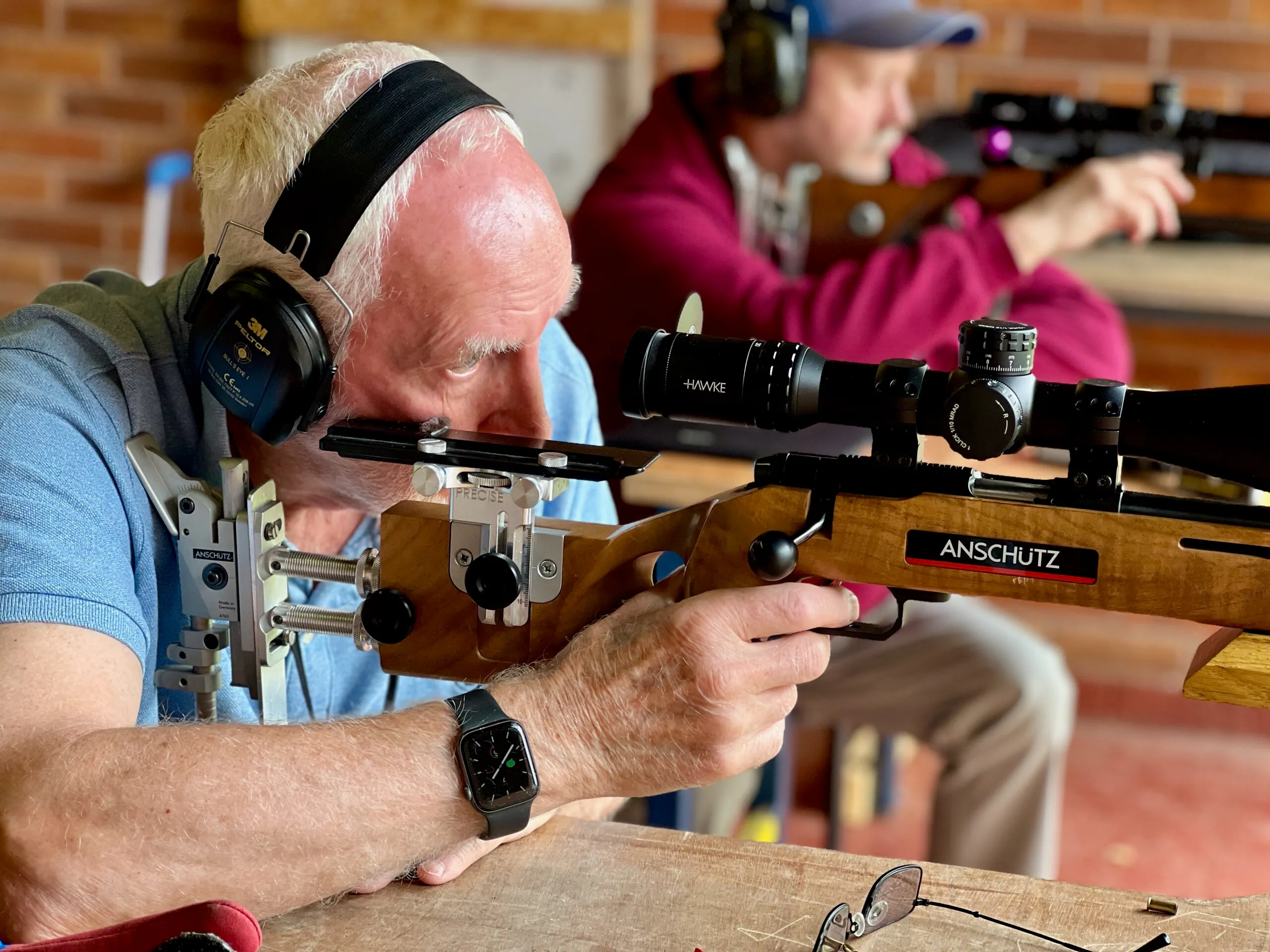
Benchrest is precision target shooting from a seated position at a fixed bench. The rifle is supported at the fore-end on a rest; the rear of the stock is held by the shooter, not by a sandbag. One shot is fired at each scoring bull, with ten scoring bulls on a card. Highest score wins, with the X-ring used to break ties.
This page describes NSRA Benchrest — the UK governing-body discipline shot at Pinhoe TSC. Other benchrest variants are shot internationally, with different rules around rests, group measurement, and rifle classes; see UK & world competition below.
No Firearms Certificate needed for air rifle benchrest. .22LR rimfire benchrest requires a Section 1 Firearms Certificate; you'll need probationary club membership for a period (typically three months minimum) before you can apply. See the getting started guide for the full process.
Match format
NSRA Benchrest is score-based, not group-based. The course of fire is the same shape at every distance:
- One shot per scoring bull
- Ten scoring bulls per card (plus separate sighters)
- Highest score wins, decided by X-ring count on tie
Distances shot:
- 25 yards (indoor) — short-range NSRA benchrest targets, outward gauged
- 25 metres (indoor) — short-range NSRA benchrest targets, outward gauged
- 50 metres (outdoor) — based on the ISSF 50m target with a white aiming centre, inward gauged
- 100 yards (outdoor) — NSRA 100-yard target with a white centre and a smaller X-ring, inward gauged
The card has separate sighting bulls so you can zero and read conditions before you fire your ten scoring shots.
Scoring
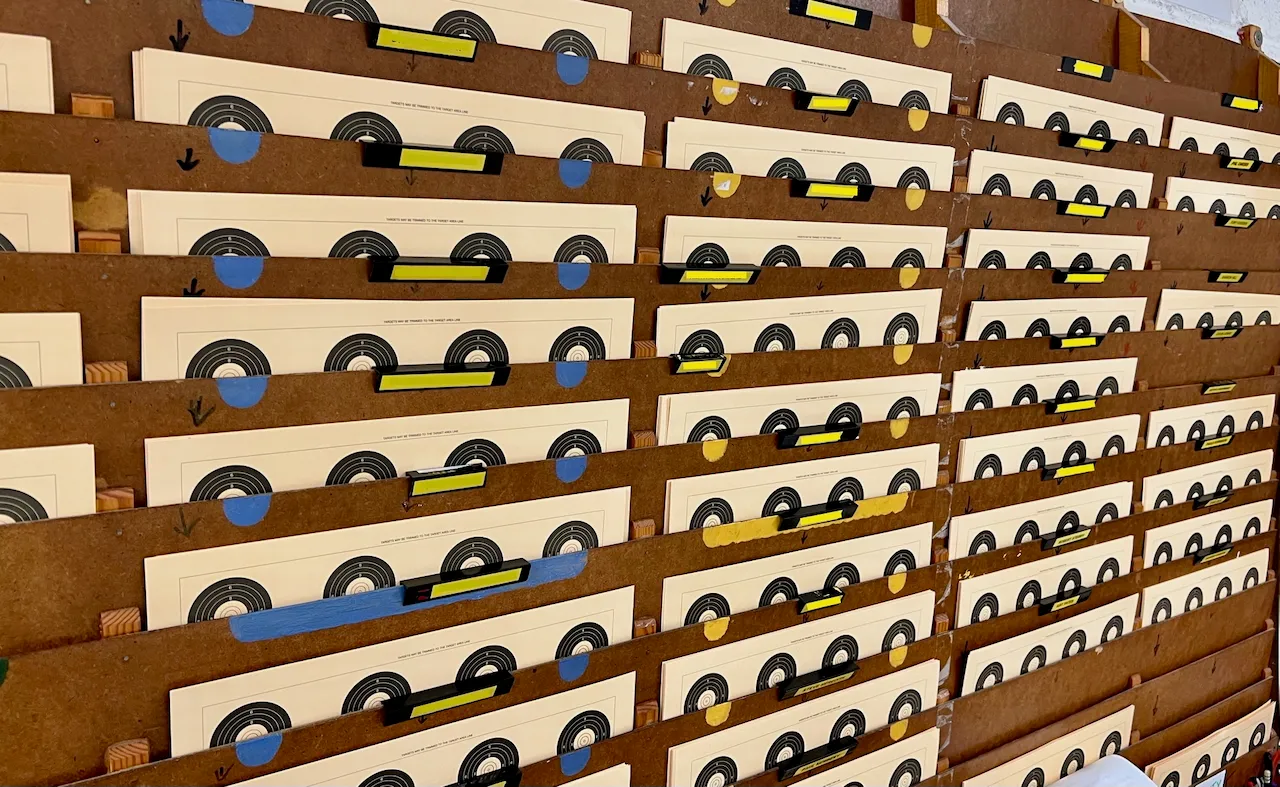
Each bull is scored on the standard NSRA ring system, with a centre X-ring sitting inside the 10-ring. A clean 10 is worth ten points; an X is worth ten points but counts separately for tie-breaking. A card of ten bulls is worth a maximum of 100 points with 10X.
Targets are gauged by an official scorer:
- Short-range targets (20/25 yd, 25 m) are scored by outward gauging — the gauge is placed in the hole and the highest ring the gauge touches counts.
- 50 m and 100 yd targets are scored by inward gauging — the bullet must completely break out the ring to count for that ring.
The X-ring is scored with a standard .22 plug gauge (or an oversize gauge for short-range X-rings).
Cards are submitted to leagues by the team captain; for club competition the scorer is usually a fellow member.
Equipment
NSRA Benchrest allows three rifle classes (NSRA Rule 8.16.1):
- Rimfire (.22 Short, Long, or Long Rifle) — bolt, semi-auto, lever or falling-block; magazines allowed but single-loaded
- Air — any .22 or smaller (.177) compressed air or CO₂ rifle. PCP (pre-charged pneumatic) is recommended in practice — springer recoil makes consistent benchrest scores much harder
- Lightweight Sport Rifle — allowed under benchrest rules without the LSR weight/trigger limits
A fore-end raising block of up to 75 mm width can be fitted to the rifle (Rule 8.16.1.3) to give the rest a flat surface.
Rests and supports:
- One rest at the fore-end only (Rule 8.16.3.2). You can use a sling instead of a rest, but not as well as.
- No rear bag, sandbag or other rear support when the rifle is in the firing position (Rule 8.16.3.5). The non-firing hand supports the rear of the stock.
- The bench top can have an elbow-comfort mat up to 20 mm thick (Rule 8.16.4.2).
This is the main difference from World Rules / WRABF benchrest, where a pedestal front rest plus a sandbag rear support is the norm. NSRA Benchrest is deliberately closer to "natural" shooting — the rifle is still held, not bagged.
Clothing and accessories:
- Glove on the non-shooting hand is permitted, ≤50 mm above the wrist, flexible material (Rule 8.16.3.6 → 8.7).
- Shooting jacket is permitted under the same flexible-only rules as other NSRA disciplines (Rule 8.16.3.7), but most benchrest shooters don't wear one — there's no recoil to manage and the position doesn't benefit from the rigidity prone shooters use.
- Ear protection is standard for all rimfire shooting and recommended for air.
Realistic prices (second-hand is much cheaper than new):
- Entry-level air benchrest: a club-ready PCP target air rifle and a basic fore-end rest is well under £500 second-hand.
- .22LR benchrest at club level: a good second-hand sporting or target .22 with a target scope can be put together for £400–£800. New target rifles run higher.
- Top-end custom competition rifles do exist at four-figure prices, but they are not the entry point.
The single biggest performance lever after the rifle is ammunition for rimfire benchrest. Every .22LR action has batch preferences; serious competition shooters will batch test match-grade ammunition (Lapua, Eley, RWS, SK) and buy in bulk from a preferred batch. For club shooting, any decent match-grade ammunition will give you a good time.
Technique
The rifle is held: the butt sits in your shoulder, your firing hand grips the hand grip, your non-firing hand supports the rear of the stock from below. The fore-end sits on the rest; the rear of the rifle never touches the bench when you're firing.
Consistency is everything. The same shoulder pressure, the same cheek position, the same hand placement, the same trigger press, every shot. The rest takes the rifle's weight; the shooter's job is to remove their own variability from the equation.
Outdoors, wind reading is the defining skill. Watch the flags between shots; either hold off in the scope or dial the turrets. The aim is to fire when conditions repeat, not when they look calm.
UK & world competition
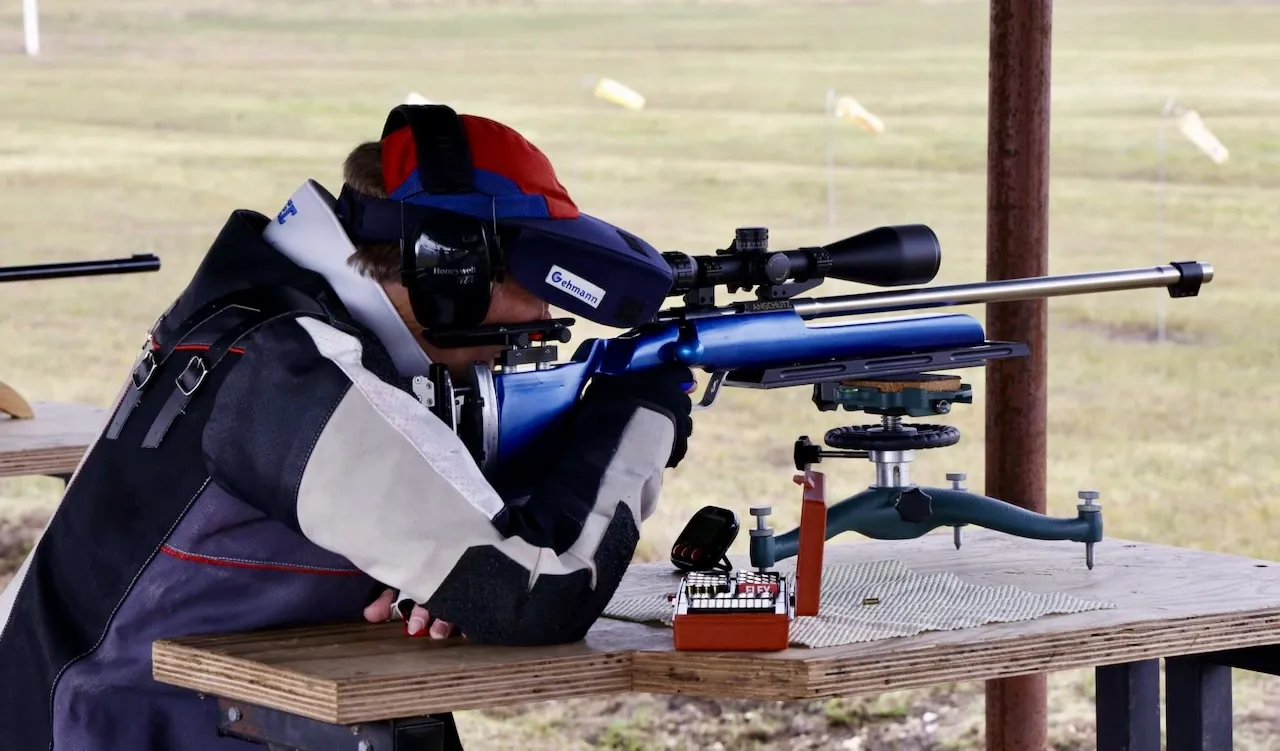
In the UK, the NSRA governs benchrest. The main competitions include:
- NSRA postal leagues — winter and summer leagues for both air and rimfire benchrest; shoot a card during a regular club night, the team captain submits
- NSRA British Championships — annual championships held at Bisley with classes for rimfire and air
- Club opens — clubs across the UK host opens through the year
Internationally, the World Rimfire and Air Rifle Benchrest Federation (WRABF) runs a different variant — group-shooting at 25 m, 50 m and 100 yd, with a pedestal rest plus a rear sandbag and groups measured edge-to-edge. WRABF Europeans and Worlds are biennial; British shooters compete under separate WRABF UK rules when training and qualifying for those events.
The two formats co-exist in the UK: NSRA score benchrest at club and national level, World Rules / WRABF group benchrest for international competition. The equipment overlap is large but not total.
At Pinhoe TSC
Pinhoe TSC shoots predominantly NSRA Benchrest across both indoor and outdoor distances:
- Pinnbrook Right — 25 yard indoor benchrest range, 5 firing points
- DJB 50m Outdoor — 50 metre outdoor benchrest, 4 firing points
We compete in NSRA postal leagues for both air and rimfire benchrest, and host an annual benchrest open (the Big Shoot) in June, although it is not held every year.
If you're new to benchrest, start with our Give it a Go programme — no Firearms Certificate, club equipment provided.
Related disciplines also offered at Pinhoe: Air Rifle Benchrest, .22LR Prone Rifle, Prone Air Rifle.
Try benchrest at Pinhoe TSC
Start with air rifle benchrest — no Firearms Certificate required. Progress to .22LR once you have your FAC.